Wednesday, January 23, 2008

For All the Michael Moore Doubters

It is no secret that the United States has one of the worst medical systems of the developed world. Earlier this month the Economist wrote a short article addressing this issue. According to a graph they published with data from the London School of Hygiene and Tropic Medicine, America ranked #19 out of the 19 wealthiest countries.

The survey they conducted tested the decline in preventable deaths for males aged 0-74 between the years 1997 and 2003. The United States posted a 4% decline while Austria, who had the greatest decline, reduced the number of preventable deaths in their country by a margin of just over 25%.

Below is the graph:


I must apologize to my skeptical conservative readers but for those of you who fear universal health-care, you are absolutely incorrect. First of all, privatized medicine will not disappear. It will stay just the way it is, an institution meant for wealthy people. There seems to be a lingering communist-phobia that has carried over from the Cold War years.

How is it that the wealthiest country in the world continues to fail millions of its citizens by not providing them health care? I for one am appalled and you should be too! The time has come for reform. Will the next president finally take care of our sick and poor? Only time and the pharmaceutical companies will tell.


Wednesday, January 9, 2008

A Martyr is Born: Benazir Bhutto


Millions the world over were horrified to hear that Benazir Bhutto, the resilient leader of the Pakistan People’s Party, had been assassinated in Rawalpindi. Much has happened in the short days since her untimely death. Her 19 year old son has been crowned as her political successor and in the meanwhile her husband, the co-chairman of the Pakistan People’s Party Asif Ali Zardari, will be in charge of the party. Her son will be ineligible to run for office for another six years and because of this Benazir Bhutto has left a huge political vacuum in her wake.

The date of the Pakistani elections has also been delayed. Instead of being held on January 8th, they will now be held on February 18th. President Pervez Musharraf has admitted to being unsatisfied with the investigation looking into her death despite suspicious government reports claiming the blast of the attacker, not a gunshot wound, was responsible for her death. In the meantime he has invited a team of specialists from England’s Scotland Yard Metropolitan Police to investigate her assassination.

Postponing the election has caused a great deal of outrage as well as an increase in a loss of faith in the Pakistani government. Bhutto’s supporters in the PPP have claimed that Musharraf simply postponed the elections because his party felt he would lose the election in the wake of such a controversy and that they were worried the PPP would gain a great deal of sympathy votes. Musharraf’s representatives claim that holding an election in the wake of such a tragic assassination is out of the question because of the level of tension that has been created. With so many unanswered questions remaining, they feel the best course of action is the one that they have taken, delaying the vote.

In the wake of all this chaos the nagging question remains elusive, “Who killed Benazir Bhutto?” Such a question is never an easy one to answer when a political assassination is involved. There are still many in the United States who feel JFK’s assassination is an unsolved mystery so imagine trying to solve such a case in Pakistan. With accusations flying any and every direction, Benazir Bhutto’s murder will certainly be a challenge to solve and likely will always be a case with a big question mark stamped on it.

There are just too many theories out there to make a precise guess as to who had killed Bhutto. Angry members of the PPP first accused the United States of helping to arrange the assassination considering that they have been in bed with Musharraf, who is essentially a dictator who came to power through a military coup. Although the emotions may be correct, the logic is quite flawed. Especially in the last year, the relationship between the Bush administration and Musharraf has become strained. Pakistan has agreed to partner up with the US against the “war on terror” but as not been fulfilling many of the obligations they said that they would in Waziristan. Waziristan is the mountainous region of Pakistan that borders Afghanistan and is the source of power for Al-Qaeda being that they get many recruits as well as arms through Waziristan into Afghanistan.

Musharraf has been reluctant to move into Waziristan with a full force because his power and stability relies on at least a cordial relationship with the citizens of Waziristan. The United States viewed Bhutto as a viable future partner in the “war on terror” and also felt that if she were elected it would stand as testament to Pakistan’s ability to hold a fair and transparent democratic election. Obviously it’s impossible to be 100% sure that there was no US involvement, but the odds that they were involved at all are quite low.

Musharraf, on the other hand, is a person that certainly stood to gain something from Bhutto’s death. The original elections, which were to be held January 8th, were looking grim for President Musharraf. Bhutto’s return to Pakistan had galvanized a huge swathe of support for her because many Pakistanis have become unhappy with Musharraf. She has also been the leader of Pakistan on two separate occasions and was the heiress to a powerful political family. Killing Bhutto, or at least creating a situation where it would be possible for an outsider to do the job, is not totally out of the question. Yet, one has to consider the implications of an assassination of such magnitude.

Since Bhutto’s death Pakistan has been in utter turmoil. Pakistan is one of the most volatile countries in the world and the last thing a contentious leader wants to do is assassinate his closest rival right before an election. Musharraf came into power through a coup and knows how easily the tides of power can shift in that country. Furthermore he knows that he is not in the best light of the United States government and most people in many countries do not support the man. The last thing he needs is a foreign investigation team to pinpoint the source of the attack to him or people close to him. Perhaps people within the ISI (Inter-Services Intelligence) helped set up the attack. Even so it doesn’t mean Musharraf had knowledge of it. Let us not forget that Wall Street Journal reporter Daniel Pearl was led to his captors by a member of the ISI. There is always the possibility that he indirectly allowed it to happen but he certainly was not the mastermind behind the attack.

It is the opinion of this journalist that the most likely culprit is some sort of extremist religious group. It is no secret that many in the United States were hoping Bhutto would win the Pakistani presidency. Being that Pakistan is such a turbulent, yet important country; many felt that having a moderate woman as president would be crucial in convincing the world that Pakistan is an open and stable country. Before arriving to Pakistan, the US had been catering to her trying to convince her to team up with Musharraf. Many religious groups such as Al-Qaeda as well as dozens of others had more than enough reason to want to assassinate her. In fact, the moment she arrived in Pakistan after her self-imposed exile, a suicide bomber blew himself up among the masses missing Bhutto but taking roughly 120 innocent lives with him.

Assassinating Bhutto, from their perspective, would cause turmoil in Pakistan. Well, Bhutto is now dead and the country is in chaos. Such a situation is ripe for major power shifts and it is no secret that there is a strong extremist movement currently in Pakistan. The religious parties control huge swaths of the country and are becoming stronger every day. If anybody truly stood to gain from this barbarous act, it is this writer’s opinion that it in some way involved politico-religious forces within Waziristan.

The current investigation going on in Pakistan will hopefully yield enlightening insights into her death. Although Bhutto had a political history fraught with corruption and drama there was much hope placed on her shoulders. Bhutto’s death is surely saddening and the prospects of what could now happen are frightening. We must all pray for the well-being of this unstable nuclear-armed country, pray for peace and prosperity.


Monday, December 31, 2007

Update Costa Rica: Part 1 "Initial Observations"

Many weeks have passed since I submitted my last article. For that I must apologize, but I was struck with a severe fever of laziness while lounging out for a month at the beach in Nosara, Costa Rica. I have now been officially living in this rich Central American country for three months. Adjusting to life here has posed its challenges and I am meeting them with a joy and determination I never would have thought possible.

This is the first time that I have actually lived in a foreign country and going through this experience as a “foreigner” has been truly eye-opening. In the United States I grew up around foreigners. I knew people from Israel, China, India, Korea, Japan, Iran, Iraq, Yugoslavia and enough from other countries so that we could have created our own United Nations of Orange County. I grew up thinking that being a foreigner must be so exciting and a constant adventure. I began travelling at age 1 and so I figured that the immense joy I felt while being in a new culture abroad must feel like that all the time for foreigners living in my country. The last few months in Costa Rica has been an important lesson in understand the plight of the foreigner in my own country.

Not being from the country you’re living in is hard. No matter how much you love a place there are always the challenges of absorbing a new language, accommodating your body to the food, learning how to get around, making friends etc. The list is endless. The entire process of solving troubles is a journey that any foreigner goes through. Although I can’t say that living here in Costa Rica I have experienced “culture shock”, I do learn everyday how different I am from everybody else here, although I must clarify this statement.

On a fundamental level I believe that all human beings are essentially the same. Of course there is always an exceptional aboriginal tribe that seems to defy our conceptions of “normal” human behavior, but I believe I am fairly safe in making the following observations. I believe that most humans in all parts of the world want the same things: a place to call home, a means to making a decent living, having people in their lives that they may call their “loved ones” and simply to have the opportunity to live happy and fulfilling lives.

This does not mean that even though we are the same in the core of our beings that it is impossible for people to feel foreign. The human race has an ugly history of intolerance, and on a less extreme level we tend to have uncomfortable dislikes for that which challenges our conceptions of our everyday reality. Simply put, foreigners are treated differently no matter where they are in the world. This isn’t always bad, but it’s a feeling that one experiences every single day of existence while being in a foreign country. Personally, every time I step out of my house I immediately feel different from everybody and out of place. It can be something as small as not knowing how to say “zipper” in Spanish and as big as having bus drivers not stop for me if there’s nobody else at the stop.

Sometimes, before I even open my mouth many people will speak to me in English. It doesn’t matter that I’ve lived here for months and that I speak the language; I’m just obviously not Costa Rican. Costa Rica is chalk full of tourists, so I obviously become upset sometimes when people automatically assume I’m a tourist. I am certainly a guest in this country, but I am by no means a tourist.

I have had interesting experiences in some of the more heavily toured areas of the country where, after only a couple sentences in Spanish using the local lingo prices fall at least in half. There are definitely two economies that exist in Costa Rica: the Costa Rican economy and the Gringo economy. What this means is that in areas where tourists can be found, there are ex-patriot Americans and Europeans selling their wares at American and European prices. Many unknowing tourists who don’t want to wander the three blocks into town to find the locals often end up getting ripped off by the Americans and Europeans, doling out money that no Costa Rican would ever pay while the Costa Ricans who sell goods at normal local prices often miss a great deal of the tourist economy. Although tourism has obviously brought a great deal of opportunity and money to Costa Ricans, much of what comes through in that industry still ends up in foreign hands. In fact, a great deal of the money Costa Ricans see from tourism is by getting jobs from businesses that foreigners own. They often earn little more than $2 an hour while the outsider earns 1st world money while paying 3rd world wages. Although I feel this is the norm there are also great exceptions. For instance some of the surfer kids I know in Nosara make $40 a lesson teaching people how to ride waves.

Although this phenomenon can be quite frustrating, one accepts it as a part of life here.

The food on the other hand, is amazing and much less depressing than the local economy. Costa Rica is about as tropical of a country as they come and the fruit is absolutely astounding. All over the highways one can find papaya, mango, coffee, guava and a slew of other amazing plants that bear fruit almost anywhere a root can find the earth. Most everywhere in the country one can buy a cold fresh coconut for forty cents. I’ve barely been here more than three months and have learned about at least twenty new fruits since my arrival.

Aside from the amazing selection of tropical goodies available at the most dirt cheap prices imaginable, the local cuisine is not lacking. The most typical plate you will find here is the famous Tico casado. Casados generally come with rice and beans (or sometimes gallopinto which is rice and beans prepared and mixed together) some vegetables, a small salad and a meat dish. There are dozens of local dishes but you can’t get more Costa Rican than a good old fashioned casado.

Getting used to the culture in Costa Rica has definitely been a sort of spiritual practice for me. I moved here after two years in Los Angeles where the pace of life is a steady pace of “not enough time”. People drive fast, eat fast, talk fast and live fast. Costa Rica maybe isn’t the most opposite place on earth compared with Los Angeles, but it’s awfully close. The most commonly heard motto hear is Pura Vida and this local saying beautifully captures the essence of this country’s culture. Everything here is just so incredibly laid back. The vibe you get when you go out in public is “what’s the rush?” That is, unless you’re driving. City driving is like playing Russian Roulette; you probably won’t die, but you might.

Becoming accustomed to the slow pace of life is here was quite a challenge at first. Depositing a check at the bank can easily be a one hour ordeal. Don’t be surprised to find two tellers helping fifty waiting customers and be even less surprised when the line continues to fill up and one of them takes their coffee break. It has also been a great test of my patience getting used to how people give directions. I went from being given a precise address and cross-street to, “Take the highway until you see the green painted bridge. Get off at the dirt road and the house is located 70 meters past the mango tree. You’ll know you’ve gone too far if you see the coffee plantation.” Keep in mind directions like this are given even though “the highway” is what every single highway is called here, half the roads are dirt, mango trees grow like weeds and there’s probably 10 coffee plantations per capita. All in all it’s not such a bad system once you get used to it. Once you come to terms with the fact that you will never get anywhere on time it’s all good. Pura Vida, right?

Be sure to stay tuned because now that you’ve gotten an introduction to Costa Rican ways of life the next part in this series will focus on my month in the beach town of Nosara.

Monday, October 22, 2007

Killer Monkeys?

Although this is obviously not funny because it resulted in somebody's death...this really is pretty hilarious and I felt that I had to share this with the world.

Killer Simians!!!


For the record, I have actually been to India and spent a good portion of my time in New Delhi. I can vouch for these poor people that the monkeys there are crazy! Where else in the world do policemen use aggressive monkeys to hunt down smaller aggressive monkeys?


Simian Wanted: Suspect is considered to be armed and dangerous.

Monday, October 15, 2007

Can We Please Move On?


It’s been awhile since I started this blog, and the time has finally come to post an article complaining about the George W. Bush administration. It was only a matter of time before I could resist the chance to exercise my right as an American to free speech, and say a few words from my little hole in Costa Rica.

The last few days I have found myself feeling dumbfounded by the fact that we elected this man a second time (or was it actually the first) to one of the most powerful positions on the face of the planet. Especially considering the fact that “the other guy” we could have voted for back in 2000 recently was awarded the Nobel Peace Prize.

It seems like one never can really tell what President Bush has up his sleeve, and where his interests lay. During his first presidency, the Republican Party managed to squeeze through a Medicaid bill that cost our government far too much money, and was clearly to galvanize more of the elderly vote for our conservative Elephants. Not that I’m against legislation that helps our nation’s sick, but at the time I was highly skeptical and these last couple weeks I have realized where this skepticism has risen from…

George Bush is not an actual human being. He is, in fact, a highly sophisticated robot designed by the Nixon administration during the Cold War as a last resort weapon against the left-wing hippies and eco-bolsheviks that would dare threaten America’s stability. How do I know this you say? How else do you explain a president that rejects a bill designed to give health insurance to our nation’s poorest children, after passing a bill to help our elderly? Nobody with a soul would ever consider vetoing such a bill. Even some of his most loyal supporters in Congress claimed that perhaps the President was just “receiving bad advice” on the matter.

Yet, perhaps I do understand where he’s coming from. We’re now engaged in a war of liberation, purging the Islamic world Muslim by Muslim of radical terrorist who loom in our midst waiting to blow us up. How could we possibly afford to help our own nation’s sick when we’re spending over a billion dollars a day blowing up other nation’s children? Lord knows we’re going to be fighting this war against terrorism for quite some time, because the way I see it, the conflicts we are currently involved in are fuelling the next two generations of vehement anti-American terrorists. Fortunately, we have private armies run by civilians such as Blackwater who gladly bill the government to defend our nation by attacking innocent civilians and drink while patrolling Iraq’s war-torn suburbs with semi-automatic rifles. Makes me proud to be an American taxpayer, that’s for sure.

Before the Bush administration blatantly fabricated a link between Al Qaeda and Saddam Hussein, Iraq’s population did not in any way want to seek revenge against the United States for any previous hostilities. Today it’s a very different scenario. Many naysayers have pointed to the fact that much of the Iraqi population wants the US military to stay for fear that the civil war will break out to an even greater extent than we have seen. Though I believe that this is true, what many are forgetting is the fact that once the dust settles between Shia and Sunni in Iraq, both sides will remember the blood spilled by Americans in a war that they feel was unjustified. An article in the Economist recently pointed out that many Iraqi’s want to kill Americans, but no just yet.

It’s not like Saddam Hussein was a shining example of human rights and ruled Iraq with fair and balanced approach. He was a brutal dictator, and met an end that he probably deserved. On the other hand, am I the only one that sees the hypocrisy of the American government in the ever-recurring patterning of supporting dictators that we like, and deposing them when we see fit? Perhaps many of my fellow citizens have forgotten our misdeeds in toppling liberal governments in Iran, Guatemala, Argentina, Nicaragua, Saudi Arabia, and El Salvador….just to name a few. One doesn’t need to look into a history book to learn about the many brutal regimes we have supported (including Iraq at one point not so long ago). Just pick up a newspaper and you’ll see our friend Pervez Musharraf, a partner in the war on terror, who controls Pakistan through the executive branch as well as the military. Of course, because he attacks his own population in Waziristan just enough to keep the US off his back, we allow him to do whatever he wants without objecting despite that it enrages another population of liberal Muslims who see nothing but the Bush administration’s willingness to support one corrupt regime and attack another.

Once again, I’m not condoning the actions of any of these groups. Waziristan is a hotbed of terrorism and has been helping to refuel the Taliban in their quest to continue oppressing the people of Afghanistan through imposed Sharia law. This too is highly unacceptable and should be condemned and dealt with, but not unilaterally by the United States. I’m just sick and tired of traveling around to different places in the world and being from “that country that attacks all the other ones”. It’s hard to explain to people you don’t support militaries when you’re from a country that has a military base in nearly ever single country on the planet for our “protection”.

I for one believe the American population would be far better off if our military expenditures were spent more on our failing education system, instead of continuously enlarging what is already the world’s biggest military budget. The US military budget is larger than the next six largest ones all put together. Are we really so in danger every day from attack that we need such a massive amount pumped into weapons of mass destruction? America and the world would be safer if we began destroying these terrible weapons instead of coming up with more creative ways to kill people. Just google “Rods from God” and you’ll see what I’m talking about.

Although this article has been aimed mainly towards venting my negative emotions about the Bush administration, I do not want to exonerate any preceding administrations either. Although I feel that this current administration is perhaps the worst this country has ever seen, many of these atrocities have gone on since this country was created and will continue for a long time. Unfortunately, basically all governments tend to be corrupt and engage in vile behavior. The world is an ugly place, and sometimes I feel those of us with privileged lives tend to forget that about 80% of the world lives in abject misery. Instead of alleviating the woes of those who needlessly suffer, we make political decisions to promote our “interests” overseas and start conflicts with perceived “enemies”.

Well I for one am sick of not saying anything about it and here I take my stand. It saddens me that the 50% of the population that does not approve of our government’s action doesn’t do anything. These people, who my elected officials tell me are my enemy, are not the enemy in the sense of a daily threat. The odds are that as long as I live I will never be involved in any incident involving some sort of armed conflict or terrorist plot, and I absolutely refuse to live me life as if I am inextricably linked to these various ongoing conflicts that the TV screens tell me are an intricate part of my life.

The people that truly scare me are the ones that continue to urge congress to take away the civil liberties and freedoms that have been enjoyed for centuries by the American people. I say no to eavesdropping, no to sweeping away members of our own population to Guantanamo like we did to our Japanese population during WWII, no to torture and secret prisons in Eastern Europe, and I say no to more war.

Saturday, September 29, 2007

Remembering a Fellow Journalist


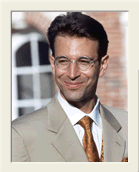
Five years ago, Wall Street Journal report Daniel Pearl was kidnapped in Karachi, Pakistan while trying to get a rare interview with a local Sheik. After an exhaustive search and rescue mission, the world learned the shocking, tragic, and brutal truth about his end as he was beheaded at the hands of his captors.

While the ruthless, inhumane terrorists that kidnapped Daniel held him captive, they repeatedly asked him what his religion was. Fully knowing what the consequences of an honest answer would be, he bravely looked them in the eye and coolly responded over and over again that he was Jewish. This refusal to buckle even under the most extreme circumstances serves as testament to his strong character, and dedication to his convictions.

Daniel Pearl dedicated his life to exposing different sides to stories that people would otherwise have never seen nor heard. He made friends wherever he went, regardless of race, sex, religion or denomination. Through his journalistic work, compassion, and love of music he was able to transcend these barriers, and he vigilantly worked towards a better world.

The Middle East is currently rife with tension, and this conflict has spread beyond the borders of these hostile lands into the very depths of our souls here in the West. Sadly, this conflict has manifested itself into an almost “Jews vs. Muslims” battle where each religious group attempts to uncover the other’s malicious and unfiltered evil.

Daniel Pearl saw beyond this conflict, and spent much of his journalistic years exposing stories that Westerners would have normally never hear about from areas such as Pakistan, Iran, and many other countries from this region. He saw that people around the world are just that, people. The vast majority of human beings are not bloodthirsty and hateful, they just want to live peacefully and have fulfilling lives surrounded by their loved ones.

In my parent’s synagogue the other day during Rosh Ha’Shana, one of the holiest days on the Jewish calendar, a man addressed the congregation basically saying that Iran must be harshly dealt with. He said that Ahmadinejad would readily drop an atomic bomb on Tel-Aviv the moment he had the chance, and that we must not stand for this and act accordingly. Although he did not directly say we should obliterate Tehran off the face of the earth, the intention of his speech was quite clear.

Such blindly hateful remarks, the kind that we decry here constantly in the United States but seem to reciprocate, can lead to nowhere but more violence and destruction. In Buddhism, it is a common practice to visualize one’s enemy and behold them as your supreme Guru. By doing so, the hoped for result is that the practitioner will realize how much of one’s own suffering is created not by an externalities, but from within.

In the upcoming days, President Ahmadinejad will be visiting New York. He will be a guest speaker at Columbia University, as well as at the United Nations. Perhaps a different response will be elicited by trying this practice of finding the good in our perceived enemies, instead of greeting them with banners that say, “Go to hell”.

What is being suggested is not to greet such leaders with bouquets of flowers, and Hershey’s Kisses. It is common knowledge that this regime is the largest state sponsor of terrorism, violently punishes homosexuality, and oppresses women among a number of other tragic practices. The point being made is that greeting such a person with equally hateful responses does not bolster our position in the West; it only makes us look hypocritical.

All too often on our television screens we see terribly sad images from the Middle East of people gathering in circles to burn Israeli and American flags, and holding up signs equating these states with Nazi Germany. Such nonsense is dangerous, and if we continue to counter these practices in the United States with similar behavior it is this journalist’s opinion that the human race is in store for a short and sad demise.

Thankfully, there are still those who have not given up hope and also believe that “giving them a taste of their own medicine” is not the best course of action to solving our modern day dilemmas. Shortly following Pearl’s death, his family united to create the Daniel Pearl Foundation. The Foundation was formed to further the ideals that inspired Daniel's life and work. Its mission is to promote cross-cultural understanding through journalism, music, and innovative communications.

Since its inception the Foundation has grown tremendously, and has influenced people around to the world to change their perspectives in profound ways. This October will be the 6th Annual Daniel Pearl World Music Days, where musicians from around the world will dedicate events in the theme of, “Harmony for Humanity”. You can check out the website at www.danielpearlmusicdays.org

Tuesday, September 25, 2007

Travel Update: Guatemala

Guatemala City, Guatemala

5:34 AM

All I can keep asking myself is, “What the hell am I doing in this airport?” At 11 o’clock last night I took off from LAX, and began a two year journey outside of my home country. I’ve been planning on doing this trip for about a year now, and I can’t believe that I’ve actually finished college, and am beginning what I have waited so long for.

I expected to feel a variety of emotions, but at this juncture the only thought that keeps running through my head is, “Gilad, you’re a freaking idiot for not paying the extra twenty bucks to get a direct flight to Costa Rica.” It’s not that the Guatemala airport is not without its charm. I mean, who doesn’t want to be sipping flavorless coffee, eating a dry croissant with some not so American cheese inside, and writing a story on their laptop at five in the morning?

Even as I type this entry water is dripping on my computer from the ceiling (or lack of a ceiling I should say). As of this moment I’m having trouble believing the signs posted everywhere that claim this is, “The best airport in Central America”. If this was the best airport in all of Central America then I’d be able to score a damned fried egg but I’ll just have to wait until I get off my next flight and land in Costa Rica. Fortunately, I have four more hours of sitting around staring out the window, absorbing the astounding glory which is the Guatemala airport construction site.

Perhaps one day I will have the fortune of exploring Guatemala, but for now I’m off to the Rich Coast. But why Costa Rica, and why now? For nearly a year and a half I have been dating one of Costa Rica’s very own native Ticas. She told me that she’d drag my gringo butt down here eventually, and despite my whining I am glad to say that it’s everything I expected. The lack of order, and abundance of life is a refreshing new breath to my life as a suburban hippie. All this, and I haven’t even left Guatemala yet!

My initial idea for this piece was to talk about my feelings as a traveler, embarking on the first baby steps of what will prove to be among the most life changing experiences of my life. How can one begin to put into words the emotions that are running through my mind? Perhaps the best way to explain it as that I’m feeling, besides exhaustion due to lack of sleep, is a little bit of everything.

Of course, I’m thrilled to start another adventure, especially one of such magnitude. Last time I bought a one way ticket I ended up traveling up and down Mexico, and made a quick pit stop in New Delhi and Kashmir to visit my girlfriend. True to form, I have bought another one way ticket chasing my girl around the globe. For me, there is no greater thrill.

So what else is running through my mind? Apprehension? Maybe. Terror? Getting warmer.

The prospect of throwing myself into the unknown for the next couple of years is not the easiest thought to digest, so to keep myself from having a nervous breakdown I’m trying not to think about it. The book I’ve chosen for this journey, “The Art of Happiness” by His Holiness the Dalai Lama, has given me some solace by strategizing the thoughts I’m allowing my mind to have. Buddhists believe that having expectations is one of the first key elements towards suffering. Of course, this is easy enough if you’re the Dalai Lama and you’ve been meditating since before you could walk, but for this Westerner trying not to think of all the upcoming possibilities has proven a difficult task. I keep glancing at the book, and the Dalai Lama never ceases to stare back at me with his genuine smile. What’s he so happy about anyways? Answer: because he doesn’t have to suffer a four hour layover in Guatemala.

Besides terror and excitement, I’m already feeling a twinge of homesickness. I spent the last three weeks living with my parents, and what an experience that was. It’s been two years since I lived with them, and it was wonderful to feel like a spoiled kid again. Of course, like any family, we bickered and fought the day I got back but the feeling of love overpowered the petty arguments that resulted from not cleaning my room…an argument I never thought I’d ever live through again, but I suppose once a child always a child.

The entire week before leaving I had to watch my mother tear up any time the prospect of my impending departure was brought up. Apart from that, saying goodbye to the rest of my family, and all of my best friends was done with a heavy heart.

I grew up traveling, but I’ve never had to say goodbye to people. It’s a strange sensation saying goodbye to people knowing you may not see them for years. The next time I come home I could very well return to married friends with children and budding careers. Gone are the days of beer pong and keg stands. Everybody is growing up and moving on with life. Everything about home will stay the same in my mind, and coming back will surely be a shock.

Before getting on my first plane, I struck a conversation with a boy perhaps five years younger than myself. I told him about what I was doing, and he asked me whether or not I was afraid of the culture shock. I pondered his inquiry for some moments before truthfully answering that culture shock was not what was on my mind, it was family shock.

My girlfriend went through it, and now it’s my turn. At this point I’ve met her parents, brother, and a handful of friends, but beyond that nobody else from her life in Costa Rica. All of this was done in the comfort and safety of my homeland. Now the tides have turned and I’m to be the new foreign spectacle who will be introduced to about 100 new people over the next week. I think about the friends, family, grandparents, neighbors, and everybody else that create the community in which a person calls home. I’ve been dating this same girl for so long and have not been exposed to hers, while she has lived many months in mine.

I am truly excited to be exposed to all these knew things, even though I’m sure it will make me uncomfortable. The discomfort I expect to feel stems for the most part from my lack of Spanish skills. I can speak fairly well, but find myself having to ask people to repeat things and not fully expressing my ideas. Half-speaking a language will make it difficult to let people know who I really am, and I have already been freaking myself out. Then I just remind myself of the Buddha’s teachings, and stop expecting anything. Everything’s going to be great, I have to keep reminding myself.

Instead of thinking of the minor awkwardness and discomfort that may possibly await me, I think about all the adventures I have planned in the near future. Before boarding I checked in my surf bag full of goodies. I made a checklist just to make sure all my toys were there:

-Two surfboards ready for any and every type of wave

-One Six foot aluminum Hawaiian spear

-One Fishing pole and tackle box

-One Snorkel, mask and pair of fins

-One Smith and Wesson switchblade for filleting the fish I hope to catch

My dream setup is no longer a dream.

For my graduation, my parents were incredibly generous and bought me a mini-HD (high definition) camcorder. To further my budding career as a journalist, I wanted a camera to help me decide whether or not I wanted to apply to graduate school in a documentary making program. I feel so fortunate to have some humble equipment in which to test the waters with over the next couple years.

I begin thinking about all these wonderful gifts life has in store for me, and that I’ve already been blessed with. To top it off, I’ll soon be boarding a plane that will take me to the love of my life, who I haven’t seen in over two weeks.

Outside at precisely this moment the sun is beginning to rise. There is a refreshing sensation of the coming of a new day, and of new life as the rains from the night are passing and clear skies are slowly wrenching apart the gray. I take this moment as a metaphor for this day in my life, that of a new beginning and a fresh clean start. What the day will hold is uncertain, the only thing that I know for sure is that the sun is only beginning to rise and that the possibilities are endless.

Suddenly the half built concrete ceilings look a bit more inviting, and sitting in the Guatemala Airport for a couple more hours doesn’t seem that bad after all.