Many weeks have passed since I submitted my last article. For that I must apologize, but I was struck with a severe fever of laziness while lounging out for a month at the beach in Nosara, Costa Rica. I have now been officially living in this rich Central American country for three months. Adjusting to life here has posed its challenges and I am meeting them with a joy and determination I never would have thought possible.
Monday, December 31, 2007
Update Costa Rica: Part 1 "Initial Observations"


Monday, October 22, 2007
Killer Monkeys?
Killer Simians!!!
For the record, I have actually been to India and spent a good portion of my time in New Delhi. I can vouch for these poor people that the monkeys there are crazy! Where else in the world do policemen use aggressive monkeys to hunt down smaller aggressive monkeys?

Simian Wanted: Suspect is considered to be armed and dangerous.
Monday, October 15, 2007
Can We Please Move On?

 post an article complaining about the George W. Bush administration. It was only a matter of time before I could resist the chance to exercise my right as an American to free speech, and say a few words from my little hole in
  dam Hussein was a shining example of human rights and ruled
 k that we need such a massive amount pumped into weapons of mass destruction?
Saturday, September 29, 2007
Remembering a Fellow Journalist
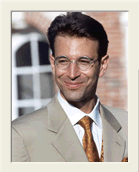
Five years ago, Wall Street Journal report Daniel Pearl was kidnapped in
While the ruthless, inhumane terrorists that kidnapped Daniel held him captive, they repeatedly asked him what his religion was. Fully knowing what the consequences of an honest answer would be, he bravely looked them in the eye and coolly responded over and over again that he was Jewish. This refusal to buckle even under the most extreme circumstances serves as testament to his strong character, and dedication to his convictions.
Daniel Pearl dedicated his life to exposing different sides to stories that people would otherwise have never seen nor heard. He made friends wherever he went, regardless of race, sex, religion or denomination. Through his journalistic work, compassion, and love of music he was able to transcend these barriers, and he vigilantly worked towards a better world.
The
Daniel Pearl saw beyond this conflict, and spent much of his journalistic years exposing stories that Westerners would have normally never hear about from areas such as
In my parent’s synagogue the other day during Rosh Ha’Shana, one of the holiest days on the Jewish calendar, a man addressed the congregation basically saying that
Such blindly hateful remarks, the kind that we decry here constantly in the
In the upcoming days, President Ahmadinejad will be visiting  f greeting them with banners that say, “Go to hell”.
What is being suggested is not to greet such leaders with bouquets of flowers, and Hershey’s Kisses. It is common knowledge that this regime is the largest state sponsor of terrorism, violently punishes homosexuality, and oppresses women among a number of other tragic practices. The point being made is that greeting such a person with equally hateful responses does not bolster our position in the West; it only makes us look hypocritical.
All too often on our television screens we see terribly sad images from the Middle East of people gathering in circles to burn Israeli and American flags, and holding up signs equating these states with Nazi Germany. Such nonsense is dangerous, and if we continue to counter these practices in the
Thankfully, there are still those who have not given up hope and also believe that “giving them a taste of their own medicine” is not the best course of action to solving our modern day dilemmas. Shortly following
Since its inception the Foundation has grown tremendously, and ha s influenced people around to the world to change their perspectives in profound ways. This October will be the 6th Annual Daniel Pearl World Music Days, where musicians from around the world will dedicate events in the theme of, “Harmony for Humanity”. You can check out the website at www.danielpearlmusicdays.org
Tuesday, September 25, 2007
Travel Update: Guatemala
All I can keep asking myself is, “What the hell am I doing in this airport?” At
I expected to feel a variety of emotions, but at this juncture the only thought that keeps running through my head is, “Gilad, you’re a freaking idiot for not paying the extra twenty bucks to get a direct flight to 
Even as I type this entry water is dripping on my computer from the ceiling (or lack of a ceiling I should say). As of this moment I’m having trouble believing the signs posted everywhere that claim this is, “The best airport in
Perhaps one day I will have the fortune of exploring
My initial idea for this piece was to talk about my feelings as a traveler, embarking on the first baby steps of what will prove to be among the most life changing experiences of my life. How can one begin to put into words the emotions that are running through my mind? Perhaps the best way to explain it as that I’m feeling, besides exhaustion due to lack of sleep, is a little bit of everything.
Of course, I’m thrilled to start another adventure, especially one of such magnitude. Last time I bought a one way ticket I ended up traveling up and down
So what else is running through my mind? Apprehension? Maybe. Terror? Getting warmer.
The prospect of throwing myself into the unknown for the next couple of years is not the easiest thought to digest, so to keep myself from having a nervous breakdown I’m trying not to think about it. The book I’ve chosen for this journey, “The Art of Happiness” by His Holiness the Dalai Lama, has given me some solace by strategizing the thoughts I’m allowing my mind to have. Buddhists believe that having expectations is one of the first key elements towards suffering. Of course, this is easy enough if you’re the Dalai Lama and you’ve been meditating since before you could walk, but for this Westerner trying not to think of all the upcoming possibilities has proven a difficult task. I keep glancing at the book, and the Dalai Lama never ceases to stare back at me with his genuine smile. What’s he so happy about anyways? Answer: because he doesn’t have to suffer a four hour layover in
Besides terror and excitement, I’m already feeling a twinge of homesickness. I spent the last three weeks living with my parents, and what an experience that was. It’s been two years since I lived with them, and it was wonderful to feel like a spoiled kid again. Of course, like any family, we bickered and fought the day I got back but the feeling of love overpowered the petty arguments that resulted from not cleaning my room…an argument I never thought I’d ever live through again, but I suppose once a child always a child.
The entire week before leaving I had to watch my mother tear up any time the prospect of my impending departure was brought up. Apart from that, saying goodbye to the rest of my family, and all of my best friends was done with a heavy heart.
I grew up traveling, but I’ve never had to say goodbye to people. It’s a strange sensation saying goodbye to people knowing you may not see them for years. The next time I come home I could very well return to married friends with children and budding careers. Gone are the days of beer pong and keg stands. Everybody is growing up and moving on with life. Everything about home will stay the same in my mind, and coming back will surely be a shock.
Before getting on my first plane, I struck a conversation with a boy perhaps five years younger than myself. I told him about what I was doing, and he asked me whether or not I was afraid of the culture shock. I pondered his inquiry for some moments before truthfully answering that culture shock was not what was on my mind, it was family shock.
My girlfriend went through it, and now it’s my turn. At this point I’ve met her parents, brother, and a handful of friends, but beyond that nobody else from her life in
I am truly excited to be exposed to all these knew things, even though I’m sure it will make me uncomfortable. The discomfort I expect to feel stems for the most part from my lack of Spanish skills. I can speak fairly well, but find myself having to ask people to repeat things and not fully expressing my ideas. Half-speaking a language will make it difficult to let people know who I really am, and I have already been freaking myself out. Then I just remind myself of the Buddha’s teachings, and stop expecting anything. Everything’s going to be great, I have to keep reminding myself.
Instead of thinking of the minor awkwardness and discomfort that may possibly await me, I think about all the adventures I have planned in the near future. Before boarding I checked in my surf bag full of goodies. I made a checklist just to make sure all my toys were there:
-Two surfboards ready for any and every type of wave
-One Six foot aluminum Hawaiian spear
-One Fishing pole and tackle box
-One Snorkel, mask and pair of fins
-One Smith and Wesson switchblade for filleting the fish I hope to catch
My dream setup is no longer a dream.
For my graduation, my parents were incredibly generous and bought me a mini-HD (high definition) camcorder. To further my budding career as a journalist, I wanted a camera to help me decide whether or not I wanted to apply to graduate school in a documentary making program. I feel so fortunate to have some humble equipment in which to test the waters with over the next couple years.
I begin thinking about all these wonderful gifts life has in store for me, and that I’ve already been blessed with. To top it off, I’ll soon be boarding a plane that will take me to the love of my life, who I haven’t seen in over two weeks.
Outside at precisely this moment the sun is beginning to rise. There is a refreshing sensation of the coming of a new day, and of new life as the rains from the night are passing and clear skies are slowly wrenching apart the gray. I take this moment as a metaphor for this day in my life, that of a new beginning and a fresh clean start. What the day will hold is uncertain, the only thing that I know for sure is that the sun is only beginning to rise and that the possibilities are endless.
Suddenly the half built concrete ceilings look a bit more inviting, and sitting in the
Friday, August 31, 2007
Brief Musings on Oaxaca
Take the beautiful and increasingly bustling fishing town of Huatulco. Avid anglers find themselves aboard the abundant pangas in search of big fish and warm fun, often shelling out thousands of dollars to embark on such an adventure for merely a week’s time. At this point in time not too many Americans make their way to this classic Oaxacan town. Most of the tourists are Mexican who come to bask in the sun and escape the foggy, polluted, and overly-crowded Mexico City. What many of these tourists fail to see is the brilliant local culture that exists all around, yet manages to stay hidden under the radar. Easily almost every single traveler in a city like Huatulco is there to get away from it all, and is not necessarily interested in learning a new perspective.
During a recent trip to Huatulco with some of my family, The Wandering Jew found himself renting ATV’s for a day of riding.around Unfortunately, there were no ATV’s to rent until the next day, and that was the day of our departure. Instead of leaving right away, a guide was suggested to us to lead a hike up the mountain for a bit.
The guide happened to be ten-year-old Carlito, an incredibly humble and bright young boy from the town at the bottom of the mountain. Carlito had lived his entire life in this rural town, and his knowledge of the surrounding landscape was immense. At my behest he nonchalantly pointed out nearly thirty different plants explaining their medicinal purpose and how to prepare them, as well as warning of various poisonous plants that would ruin anybody’s weekend if stepped on.
Intrigued, I enquired further into this young child’s life that was so mysterious and foreign to anything I had experienced growing up in urban Orange County. He began to elucidate the local curandero (healer) culture in the local area. Nobody around there used western medicine, and relied on the local mountain to provide them with all their needs.
Such interesting aspects of the local culture largely go unnoticed by most travelers in these regions. Most want to enjoy their Coronitas with a lime, on the beach, and not have to think about a thing. Completely understandable and worthy of anybody who works hard, but there are great wonders to be found in the state of Oaxaca for those with exploratory spirits.
As an interesting example, the first westerners to every use hallucinogenic ceremonial plants which locals had revered since the height of the Mayan empire were discovered in Oaxaca. In 1955 a banker, author, researcher, and amateur mycologist by the name of R. Gordon Wasson trekked to the hidden mountains of inner-Oaxaca in search of the magic-mushrooms of legend. He found one of the last of a long line of mushroom healers named Maria Sabina, who led him through the first ever mushroom healing session ever experienced by a westerner.
He later wrote an article in Time magazine describing the experience, and he inspired an entire legion of curious scientists, researchers, adventurers, spiritualists, and intellectuals who made the trek to seek the wisdom of Maria Sabina.
At the end of her life, Maria Sabina was quoted as saying that after the westerners came, the mushrooms had lost their powers and were corrupted by the hedonistic misuse of the whites who had come seeking God. She said that God was not what they [the mushrooms] showed, and that they were used for healing purposes only.
Nevertheless, there are stories of a few of these ancient healers still living in the Oaxacan mountains. Shamanism plays a large role in the life of many rural Oaxacan villages, and it is in these unheard of towns where the true travelers may also be found. The true adventurers who get by on twenty dollars and their wits for weeks at a time.
Who is to say what is a better experience, and whether or not the life of an adventurer is for everybody. There truly is no right answer. Yet, one fact remains. There aremany uncovered treasures that remain to be seen for those who are willing to find them in the magical Mexican state of Oaxaca.
Monday, August 27, 2007
The Piercing Jordanian
Why I was in Berkeley in the first place is another story. My brother was recently accepted as a Developmental Studies major, and so in typical fashion we loaded up a van full of junk and people and made the lonesome trek up the I-5 into the beautiful Bay Area. I myself was interested in checking out UC Berkeley’s Journalism program, but was glad to have a few extra days to just hang out and absorb the diversity which characterizes this great town.
I have probably been to Berkeley nearly a dozen times, but the uniqueness of the town never ceases to impress me. Perhaps its most striking feature is the deep sense of history and connection with the sweeping cultural revolution of the 1960’s. Berkeley is no longer the free for all, twenty four hour a day hippie circus that it once was. Fortunately for those of us born post 1970, it’s still pretty damn close. Groups of grungy street folk can be found up and down Telegraph asking pedestrians for money, food, and marijuana. Most seem to prefer getting handouts of the latter.
Vendors with hair down to their waste and beards that compete in length sell shirts claiming , “United Republic of Berkeley”, “Free Palestine”, T-shirts with Mao Zedong donning Mickey Mouse ears reading “Mickey Mao”, and other such communist paraphernalia that my Cold War era parents would shake a stick and decry as Stalinist in a heartbeat. As I wheedled my way through the throngs of dreadlocked wannabe rastas, new age Goths, meth freaks, ganja freaks, young hippies, old hippies, hippy dogs, conservative dogs, professors, frat students, and the occasional tarot card reading drug addict that can supposedly understand the universe and my future better than I because of he has been doing acid for forty years, I came to a realization. This was not the same Berkeley that my old professors in college used to attend in the 1960’s.
In fact, I remembered a story a professor of mine at junior college relayed to me once during a casual conversation in her office. This professor, who is perhaps the most adventurous woman I have met in my life, was the nerdiest student in the annals of Berkeley history. Allow me to explain:
Apparently one year during my professor’s time as a student in Berkeley, she found herself in her room studying for class. She was trying hard to concentrate on the material in front of her, but could not focus due to the ruckus coming from the room next door. Certain that if she didn’t do something about the noise, she would never get all the reading done for her class the following morning. As any eager and polite student would do, she got up to go see why there were so many people listening to loud music in the room next door, and would kindly ask them to keep it down.
It just so happened that the “ruckus” next door was non other than the quintessential 1960’s Berkeley psychedelic rock band The Doors playing at a small party. Anybody in their right mind would have asked for the nearest hit of LSD and joined the fun, but of course this professor of mine asked them to turn in down. Her request was met with little recognition, and instead of hanging out and listening to one of the most iconic bands of all time she returned to her room and continued her futile efforts to study.
For better or for worse, Berkeley is definitely not the same haven of radicalism and free love that it once was. Men and women in business suits can be seen walking around, as well as serious minded students who have no patience for nonsense of any sort. The spirit, in many ways, is still there but as Bob Dylan would say “Oh the times they have a changed”.
So now back to the piercing Jordanian.
When I was younger I had my left ear pierced, as well as my left eyebrow (I know what you’re thinking, and yes, I was definitely the coolest kid at my high school). For some inane reason about a year ago I thought that, since I’m graduating college soon maybe I should clean up my look a little. So off came the grizzly beard, my gorgeous long curly locks, and the sacrilegious metal hunks in my body. Although I can’t say it wasn’t refreshing to release myself of years of partly dreaded shoulder length curls, I missed my hair both facially and cranially within a month.
One year after that fateful day I found myself in Berkeley, back in full swing with an even more massive beard and a competing mane of curls. I had been thinking of getting my ears pierced as symbol of a new beginning, because as I write this article I am getting ready to move to Costa Rica in about three weeks to start a new life. I hadn’t made up my mind as to whether or not I really wanted to go through with it, but I happened to walk by a piercing shop and peeped in to see how much it would cost.
The price was fair, and the store seemed like a highly professional operation with a lot of traffic. I told an employee I would think about it over lunch.
Five minutes later I turned around and told the guy up front that I had thought about it enough, and so he took me to the back of the store to pierce my ears. Because I had pierced my a few years back, I wanted to know whether or not it was ok to re-pierce it. “My old pierced ear shouldn’t be a problem right?”
“Nah, shouldn’t be any problem at all, friend,” he amiably responded.
As soon as he responded I was certain that his accent was Middle Eastern. My curiosity aroused, I asked him, “What country are you from? I can’t quite place the accent, although I’m pretty sure you’re from the Middle East.”
“I am Jordanian,” he casually responded. As soon as he had said that I remembered the stories my Israeli cousin had recently told me about being in an airport in Jordan while in transit to India, and the disapproving looks he was given for being Israeli. Berkeley isn’t exactly known as being a bastion of Israel loving citizens regardless of background, and I was certain the conversation would become awkward for me since most of my family lives in Israel. All too often growing up in a Jewish community I had heard about the deep hatred all Jordanians harbor towards anybody with any relationship to Israel. “How could you tell it was a Middle Eastern accent? Most people think Mexican,” he joked with me.
Well, I’m sure as hell not going to hide it, I thought to myself. “My family back in Israel are from Iraq…Baghdad of all places. None of them live there anymore obviously,” I coolly responded. I knew some kind of derisive comment or look because I mentioned my family was Israeli was getting ready to emerge.
“Wow! Israel. I pray that one day I may get to go there. Right now I am too afraid because of the terrorism, but I hope for peace there so that I may one day visit.” My jaw nearly dropped as I realized how foolish, and prejudice I was for thinking he would feel negatively about me having Israeli family. I was a little upset at myself, but also interested by this compatriot from the Middle East.
“How long have you been in the states for?” I inquired.
“Twenty years, believe it or not. I still have this accent as strong as ever. But, I truly love it here, America is truly the land of the free. In Jordan we had no freedoms, but here…here I can do whatever I want as long as I work hard.”
The surprises seemed to keep coming. This Jordanian Muslim’s patriotism far exceeded anything I harbor for my country. I can’t wait to move out of this country, and this Jordanian never wants to leave it!
This experience was important for me to go through in these highly racialized times. It seems as if everybody has become so politically correct that we are often blinded to prejudices we ourselves harbor. There is no such thing as a completely unbiased person, especially in the United States where many minorities feel like the only thing that has improved since the Civil Rights movement is that segregation is no longer institutionalized and codified. Many of the same attitudes persist to this day although I also think it’s silly, maybe even dangerous, to say that race relations haven’t improved in the United States in the last 40 years.
It was sobering to think about how much my opinion had been shaped of Jordanians because of one cousin’s experience that he shared with me, and because of what I had heard as a child growing up. I began to lament the current degraded relationship between Jews and Muslims at home, and around the world. Many are afraid to come out and say it, but there is a very real resentment among many Jews towards Muslims, and many Muslims towards Jews. Many from my generation tend to not fully subscribe ourselves to the same ideas as many of our parents have, and tend to be more open minded. Despite this, the tension and many continue to believe that we should mistrust and hate each other.
Hopefully this madness will end one day, but until that day comes those of us who were raised under these various banners must realize that even of those who think we’re totally unbiased, it’s not true. Sadly, many of these beliefs are completely justified, but in my opinion being justified does not mean that people should let it affect their relationships with one another. Many Muslims have committed atrocities against Jews, and vice versa. Does this mean we must rise to arms and hatred in retaliation? If this course of action continues then it is indeed a grim world our offspring will come to inherit.
